Books

Games in the Philosophy of Biology
Surveys the use of game theory in biology and the philosophy of biology. The book considers work on signaling games, information theory, the prisoner’s dilemma, the stag hunt, and the bargaining game. It looks at questions like: what is meaning in the biological realm? How should we account for prosociality? What is the relationship between social modeling in the human and biological realms?

Modeling Scientific Communities
Surveys models used to study the workings of science, including those that look at credit incentives, selective processes in science, social network structures, epistemic landscapes, and statistical practice. Helpful to those interested in metascience and the structure of scientific communities who would like to know more about formal models of these topics.
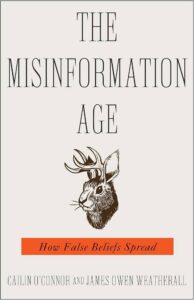
The Misinformation Age
How False Beliefs Spread
Why should we care about having true beliefs? And why do demonstrably false beliefs persist and spread without apparent consequence for the people who hold them? It might seem that there’s an obvious reason that true beliefs matter: false beliefs will hurt you. But if that’s right, then why is it (apparently) irrelevant to many people whether they believe true things or not? In an age riven by factual disputes over everything from climate change to the size of inauguration crowds, the authors argue that social factors, not individual psychology, are what’s essential to understanding the persistence of false belief, and that we must know how those social forces work in order to fight misinformation effectively.
Want to see a talk about the book? Watch here. Reviews: one by Erin Nash, and another by Steven Sloman.

The Origins of Unfairness
Social Categories and Cultural Evolution
The central aim of this book is to explore the ways that social categories – especially gender, but also categories like race and religion – interact with and contribute to social solutions to problems of coordination and resource division. In particular, this book uses formal frameworks – game theory and evolutionary game theory – to explore the cultural evolution of conventions that piggyback on seemingly irrelevant factors like gender and race to solve these problems.
One theme that runs throughout the book is that surprisingly minimal conditions are needed to robustly produce phenomena related to inequity that we usually think of as psychologically complex. Once inequity emerges in these models, it takes very little for it to persist indefinitely – so we need to think of inequity as part of an ever-evolving process, not something we can expect to fix and be done with.
Reviews: Ann Cudd, Aja Watkins and Rory Smead, and William Fitzpatrick.